
Nigeria was divided into six geopolitical zones in 1997 by General Abacha and SouthEast Nigeria is one of them. As the name suggests, the South East is located in the eastern part of the country. This region is predominantly inhabited by one major ethnic group in Nigeria you will find out as we proceed.
South East Nigeria is known for its rich culture, strong entrepreneurial spirit, fertile land, educational institutions, and growing investment opportunities.
Where Is South East Nigeria Located?
Geographically, South East Nigeria lies approximately between latitude 4°17′N and 7°06′N and longitude 5°23′E and 9°28′E.
The region shares boundaries with:
- River Niger to the west
- Niger Delta and Atlantic Ocean to the south
- Cross River State and Cameroon to the east
- North Central Nigeria to the north
How Many States Are in South East Nigeria?
There are five (5) states in South East Nigeria. The table below contains their names and other specific information.
| State | Capital | Land Mass (km²) | Population (2006 Census) | Postal Code | State Slogan |
|---|---|---|---|---|---|
| Abia | Umuahia | 6,320 | 2,833,999 | 440001 | God’s Own State |
| Anambra | Awka | 4,865 | 4,182,032 | 420001 | Light of the Nation |
| Ebonyi | Abakaliki | 6,400 | 2,173,501 | 840001 | Salt of the Nation |
| Enugu | Enugu | 7,161 | 3,257,298 | 400001 | Coal City State |
| Imo | Owerri | 5,530 | 3,934,899 | 460001 | Eastern Heartland |
From the table above, the states that make up South East Nigeria are Abia, Anambra, Ebonyi, Enugu, and Imo.
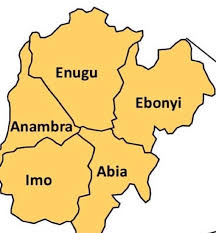
Land Area and Population of South East Nigeria
The South East occupies a total land area of approximately 30,276 square kilometers, making it one of the smallest geopolitical zones in Nigeria by land size. According to the 2006 national population census, the region has an estimated population of 16,381,729 people.
Among the South East states, Enugu State has the largest land area, while Imo State is the most populous. Anambra State is the smallest by land size but has one of the highest population densities in Nigeria.
Ethnic Group
South East Nigeria is predominantly inhabited by Igbo language speakers, commonly referred to as Ndigbo. The Igbo people, alongside the Hausa and Yoruba, form the three major ethnic groups in Nigeria.
The region has produced many influential figures in Nigeria’s political, cultural, and economic history, further strengthening its national significance.
Culture and Tradition
The South East is rich in Igbo culture and traditions, deeply rooted in community values, respect for elders, hard work, education, and self-reliance. Each town has designated market days, traditional titles, cultural dances, and annual festivals.
One of the most celebrated cultural events is the New Yam Festival, which is observed across Igbo land to give thanks for a successful harvest. Storytelling, ancestral respect, and communal identity are passed down through generations. Regardless of where they live, Igbo parents strongly emphasize teaching their children the Igbo language, making it rare to find an Igbo person who cannot speak their native tongue.
Climate
South East Nigeria experiences a tropical climate, similar to that of the South South region. The area is characterized by high temperatures, high humidity, and moderate to heavy rainfall.
The rainy season typically begins in April and lasts until early November, lasting almost seven months. Annual rainfall often exceeds 1,730mm, depending on location and climate variations. The dry season runs from November to March, during which the harmattan wind is experienced. Average annual temperatures range between 79°F and 82°F, with Enugu State often recording slightly higher temperatures due to its proximity to the northern region.
Vegetation
The South East has two major vegetation zones: the tropical rainforest and the derived savannah. The tropical rainforest dominates the region and is characterized by dense forests, tall trees, and thick undergrowth.
Common trees include oil palm, mahogany, iroko, rubber, cocoa, and bamboo. Crops such as cassava, yam, cocoyam, and palm produce thrive due to abundant rainfall. The derived savannah exists sparsely in some areas and is marked by shorter trees, grasses, scattered shrubs, and less dense vegetation.
Commerce and Business
Commerce is a way of life in the South East. The Igbo people are widely known for their entrepreneurial spirit, trading culture, and business innovation. From rural towns to major cities, buying, selling, and manufacturing are daily activities.
Major Commercial Centers
- Aba (Abia State): Local manufacturing hub for shoes, bags, and clothing. Ariaria Market is often called “Africa’s China.”
- Nnewi (Anambra State): Known as Nigeria’s industrial town and home to Innoson Vehicle Manufacturing.
- Onitsha: Hosts one of the largest markets in West Africa.
- Owerri and Enugu: Growing real estate, hospitality, and commercial hubs, attracting investors into malls, estates, hotels, and commercial developments.
Investment Opportunities
South East Nigeria offers strong investment potential in:
- Agriculture
Fertile land supports cassava, yam, rice, palm oil, and vegetables.
- Real Estate
Rapid urban growth in Owerri, Enugu, Awka, and Onitsha is driving housing and commercial development.
- Manufacturing and SMEs
Aba and Nnewi provide skilled labor for small- and medium-scale industries.
- Technology and Education
The presence of universities and a young population supports tech hubs, startups, and e-learning platforms.
Tourist Attractions
Although the South East is known for business, it also has notable tourist destinations:
- Ogbunike Caves (Anambra State): A historic and sacred cave system.
- Awhum Waterfall and Monastery (Enugu State): A peaceful blend of nature and spirituality.
- Ngwo Pine Forest (Enugu State): Ideal for picnics, hiking, and relaxation.
- National War Museum, Umuahia (Abia State): Showcasing Nigeria’s Civil War history.
- Oguta Lake (Imo State): A scenic spot for leisure and boat rides.
These destinations make the region suitable for leisure, family vacations, and cultural tourism.
Education and Innovation
The South East hosts some of Nigeria’s leading universities:
- University of Nigeria, Nsukka (UNN)
- Federal University of Technology, Owerri (FUTO)
- Nnamdi Azikiwe University, Awka
- Ebonyi State University
- Abia State University
The region’s youth are increasingly active in technology, creative industries, and innovation.
FAQs
Which part of Nigeria is the South East?
- The South East is located in eastern Nigeria and is predominantly inhabited by the Igbo people.
How many states are in South East Nigeria?
- There are five states in the South East geopolitical zone: Abia, Anambra, Ebonyi, Enugu, and Imo.
Summary
Whether you are a traveler seeking cultural experiences, an investor looking for opportunities, or a Nigerian reconnecting with your roots, South East Nigeria offers a blend of history, resilience, enterprise, and cultural richness that is truly unique.
Leave a Reply